
Research Problem
The sudden transition to remote learning during the COVID-19 pandemic created significant challenges for educators across all levels. Teachers and faculty were required to convert traditional, face-to-face instruction into online formats in a matter of weeks, generating widespread uncertainty, stress, and anxiety (Coman et al., 2020; Hamilton et al., 2020). This rapid shift was particularly difficult for educators with limited experience using digital platforms or online pedagogical strategies (Hamilton et al., 2020). Many educators were expected to adapt quickly without sufficient preparation, which affected their confidence and effectiveness in delivering instruction. While institutions prioritized continuity of instruction, less attention was given to educators’ sense of self-efficacy, motivation, and well-being.
Although online learning offers flexibility and accessibility for students, its success depends largely on the preparedness and engagement of educators. When teachers lack sufficient training, institutional support, or motivation, the quality of instruction and student learning experiences can be negatively affected (Fernández-Berrocal et al., 2017; Hamilton et al., 2020). In addition, the emotional demands placed on educators during this transition increased the likelihood of burnout, frustration, and disengagement, further emphasizing the importance of addressing teacher motivation holistically (Fernández-Berrocal et al., 2017).
Purpose of the Study
This paper explores how Maslow’s hierarchy of needs can be applied to understand and enhance educator motivation in remote teaching contexts. Specifically, it addresses the following research question:
- How can Maslow’s hierarchy of needs be used to motivate educators to engage effectively in online teaching?
Additionally, this study considers how Maslow’s framework can be incorporated into professional development to better support educators navigating new instructional environments. By examining teacher experiences during the pandemic, this study aims to provide insights into how institutions can better address both the professional and emotional needs of educators. Understanding these needs is essential for fostering engagement, improving instructional quality, and promoting long-term sustainability in teaching practices.
Maslow’s Hierarchy of Needs
Abraham Maslow’s theory of hierarchical needs is a foundational concept in humanistic psychology, emphasizing personal growth, motivation, and self-fulfillment. Unlike behaviorist or purely cognitive approaches, humanistic psychology focuses on individuals’ lived experiences and their inherent drive toward growth and meaning (Thomas, 2005). Maslow’s perspective highlights that human behavior is driven not only by external stimuli but also by internal needs, emotions, and aspirations (Thomas, 2005).
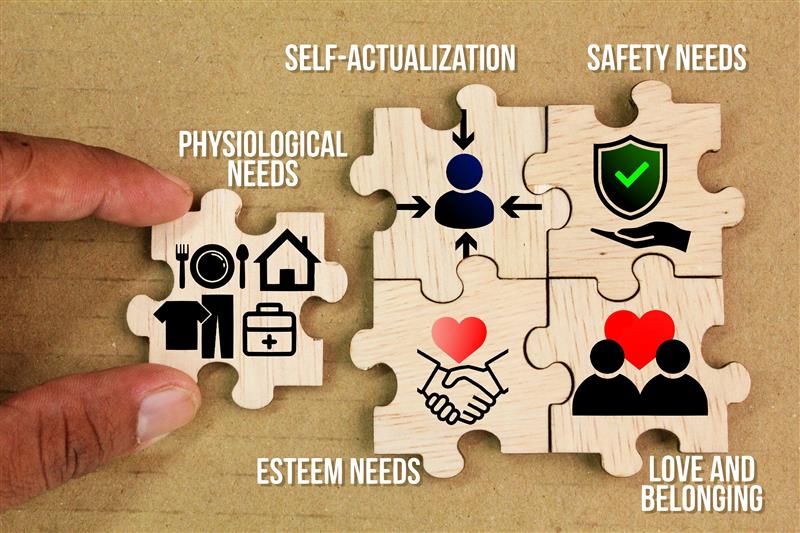
Maslow categorized human needs into a hierarchy, beginning with basic physiological needs and progressing toward higher-level psychological and self-fulfillment needs. These needs are divided into deficiency needs and growth needs (McLeod, 2020). The hierarchy includes physiological, safety, belongingness, esteem, cognitive, aesthetic, self-actualization, and transcendence needs (McLeod, 2020; Martin & Joomis, 2007). Each level represents a different dimension of human motivation and plays a role in shaping behavior and engagement.
Maslow proposed that individuals generally must satisfy lower-level needs before progressing to higher levels, although this progression can vary depending on individual circumstances and priorities (McLeod, 2020; Thomas, 2005). In educational settings, this hierarchy provides a useful framework for understanding how unmet needs can hinder motivation and performance. When educators’ foundational needs are not addressed, their ability to focus on higher-level goals such as innovation and professional growth becomes limited.
Maslow’s Hierarchy and Educator Motivation
Maslow’s framework provides a useful lens for understanding teacher motivation, particularly during times of disruption such as the shift to remote learning. Each level of the hierarchy corresponds to specific needs that influence educators’ performance, engagement, and well-being (Shikalepo, 2020). At the most basic level, physiological needs affect teachers’ ability to function effectively. Educators experiencing fatigue, burnout, or stress may struggle to maintain energy and focus in their teaching responsibilities (Shikalepo, 2020; Fernández-Berrocal et al., 2017). During the pandemic, extended working hours and increased screen time further contributed to physical and mental exhaustion.
Safety needs became especially relevant as educators navigated uncertainties related to job security, health risks, and changing institutional expectations. A lack of clear guidance or institutional support can create anxiety and reduce teachers’ ability to adapt confidently to new teaching modalities (Shikalepo, 2020; Hamilton et al., 2020). When educators feel insecure or unsupported, their motivation to engage with new teaching methods decreases.
Belongingness and social needs are also critical. Remote teaching often led to feelings of isolation due to reduced interaction with colleagues and students, which can negatively impact morale, collaboration, and productivity (Shikalepo, 2020; Coman et al., 2020). Maintaining a sense of community is essential for sustaining motivation and engagement in professional environments.
At the level of esteem, educators require recognition, respect, and validation of their efforts. When teachers feel undervalued or unsupported, their motivation and confidence may decline. Conversely, institutional acknowledgment and positive feedback can enhance self-efficacy and engagement (Shikalepo, 2020; Fernández-Berrocal et al., 2017). Recognition plays a key role in reinforcing educators’ sense of purpose and professional identity.
Finally, self-actualization reflects educators’ desire for growth, creativity, and professional fulfillment. Teachers who feel empowered to innovate and develop new instructional strategies are more likely to engage meaningfully with their work. However, when opportunities for growth are limited, educators may become disengaged or seek opportunities elsewhere (Shikalepo, 2020; McLeod, 2020). Supporting self-actualization is essential for long-term teacher satisfaction and retention.

Impact of Remote Teaching on Educator Needs
Research conducted during the COVID-19 pandemic highlights significant gaps in institutional support for educators. Although many teachers received basic technical training, they often felt unprepared to effectively engage students in online environments (Coman et al., 2020; Hamilton et al., 2020). This lack of preparation contributed to increased stress, confusion, and frustration, ultimately affecting teaching quality. Educators also reported feeling overlooked by institutional stakeholders, particularly regarding their emotional and professional needs (Coman et al., 2020). Expectations to rapidly adapt to online teaching placed additional pressure on teachers without sufficient guidance or support (Hamilton et al., 2020). These conditions created a challenging environment in which educators were expected to perform effectively despite limited resources.
Teaching has long been recognized as a highly demanding profession associated with emotional labor, stress, and reduced well-being (Fernández-Berrocal et al., 2017). During the pandemic, these challenges intensified as educators were required not only to deliver instruction but also to support students’ emotional needs in a time of crisis (Fernández-Berrocal et al., 2017). This dual responsibility increased the emotional burden on teachers. Survey data from the RAND Corporation further revealed that more than half of teachers did not receive adequate support for addressing student learning needs during remote instruction (Hamilton et al., 2020). While some educators received basic platform training, many lacked guidance on student engagement strategies and emotional support practices (Hamilton et al., 2020; Coman et al., 2020). These findings highlight the importance of comprehensive support systems.
Implications for Professional Development
Applying Maslow’s hierarchy to educator support suggests that professional development should extend beyond technical training. Institutions must adopt a holistic approach that addresses educators’ psychological, social, and professional needs (Shikalepo, 2020; Hamilton et al., 2020).
First, institutions should support basic needs by promoting manageable workloads, clear communication, and access to resources, which can reduce uncertainty and stress (Hamilton et al., 2020). Providing stability allows educators to focus more effectively on their teaching responsibilities. Second, fostering a sense of community is essential. Opportunities for collaboration, peer interaction, and professional dialogue can help educators feel connected and supported (Shikalepo, 2020; Coman et al., 2020). Strong professional relationships contribute to increased motivation and engagement.Third, institutions should provide recognition and encouragement, reinforcing educators’ contributions and strengthening their confidence and motivation (Shikalepo, 2020; Fernández-Berrocal et al., 2017). Positive reinforcement can significantly impact teacher morale. Finally, professional development should promote growth and innovation, allowing educators to explore new teaching strategies and reach self-actualization (McLeod, 2020; Martin & Joomis, 2007). Encouraging creativity and professional growth leads to more effective teaching practices.
Conclusion
Maslow’s hierarchy of needs offers a valuable framework for understanding educator motivation, particularly during periods of rapid instructional change. The transition to remote learning during the COVID-19 pandemic revealed significant gaps in how institutions support educators’ needs (Coman et al., 2020; Hamilton et al., 2020). While many efforts focused on maintaining instructional continuity, less attention was given to teachers’ well-being, motivation, and professional development. As this paper demonstrates, unmet needs at any level of Maslow’s hierarchy can negatively impact educator performance and engagement (Shikalepo, 2020; Fernández-Berrocal et al., 2017). To improve teaching and learning outcomes, institutions must adopt a comprehensive approach that addresses the full range of educator needs. Supporting educators as individuals—not just instructors—can foster more effective, motivated, and resilient teaching communities. Such an approach not only benefits educators but also enhances student learning experiences and institutional success in the long term.
References
Coman, C., Tiru, L., Mesesan-Schimtz, L., Stanciu C., & Bularca, M. (2020). Online teaching
and learning in higher education during the coronavirus pandemic: Students’ perspective. Sustainability, 12. DOI: :10.3390/su122410367
Fernández-Berrocal, P., Gutiérrez-Cobo, M., Rodríguez-Corrales, J., & Cabello, R. (2017).
Teachers’ affective well-being and teaching experience: The protective role of perceived emotional intelligence. Frontiers in Psychology, 8. DOI: 10.3389/fpsyg.2017.02227.
Hamilton, L., Kauffman, J., & Diliberti, M. (2020). Teaching and leading through a pandemic:
Key findings from the American educator panels. Spring 2020 COVID-19 Surveys. https://www.rand.org/pubs/research_reports/RRA168-2.html.
Martin, D. & Joomis, K. (2007). Adapted from Building teachers: A constructivist approach to
introducing education. Cengage Learning.
McLeod, S. A. (2020, March 20). Maslow’s hierarchy of needs. Simply Psychology.
Shikalepo, E. (2020). The role of motivational theories in shaping teacher motivation and
performance: A review of related literature. International Journal of Research and
Innovation in Social Science (IJRISS), 4(4).
Thomas, R. (2005). Comparing theories of child development. Cengage Learning.
Sharon Diaz Ruiz, Ed.D. , Assistant Professor of English, AGMU